
Why ChatGPT Doesn’t Understand Many Websites – And What Businesses Can Do About It
Over the past twenty years, businesses have learned to optimise their websites for Google. Keywords. Backlinks. Meta tags.
But something fundamental is shifting. More and more people are no longer searching on Google. They’re asking their questions directly to AI systems like ChatGPT, Gemini, or Copilot.
The key question is no longer just: “Does our website rank on Google?”
But rather: “Can an AI even understand our content?”
In many cases, the answer is unfortunately: no.
The Problem: Websites Are Written for Humans, Not for Machines
Most business websites follow a classic logic. A homepage with marketing promises. Several subpages with products or services. Plus PDFs, documents, and FAQs.
For humans, this usually works well enough. For AI models, however, not always.
A language model tries to extract information differently than a human. It looks for clearly formulated statements, structured content, and unambiguous relationships.
When content is too abstract, things get difficult. A typical sentence on business websites might be:
“We develop innovative solutions for sustainable business success.”
That sounds good. But it says practically nothing. A language model can barely determine what exactly the company does, who the offer is for, or what problem is being solved.
A clearly formulated sentence would be, for example:
“Our software automates customer enquiries in customer service.”
That sentence is understandable for humans – and for AI as well.
Why LLMO Is Suddenly Becoming Important
This is where a new topic comes into play: LLMO – Large Language Model Optimisation.
While classical SEO aims to rank better in search engines, LLMO is about preparing content so that AI models can understand, cite, and use it in responses.
This is no longer a theoretical discussion. More and more users are asking things like:
- “Which pension fund is good?”
- “Which further training suits me?”
- “Which software helps with customer service?”
When an AI system formulates an answer, it draws on content it finds on the internet. Websites whose content is clearly structured and comprehensibly written have a decisive advantage: they are cited more often.
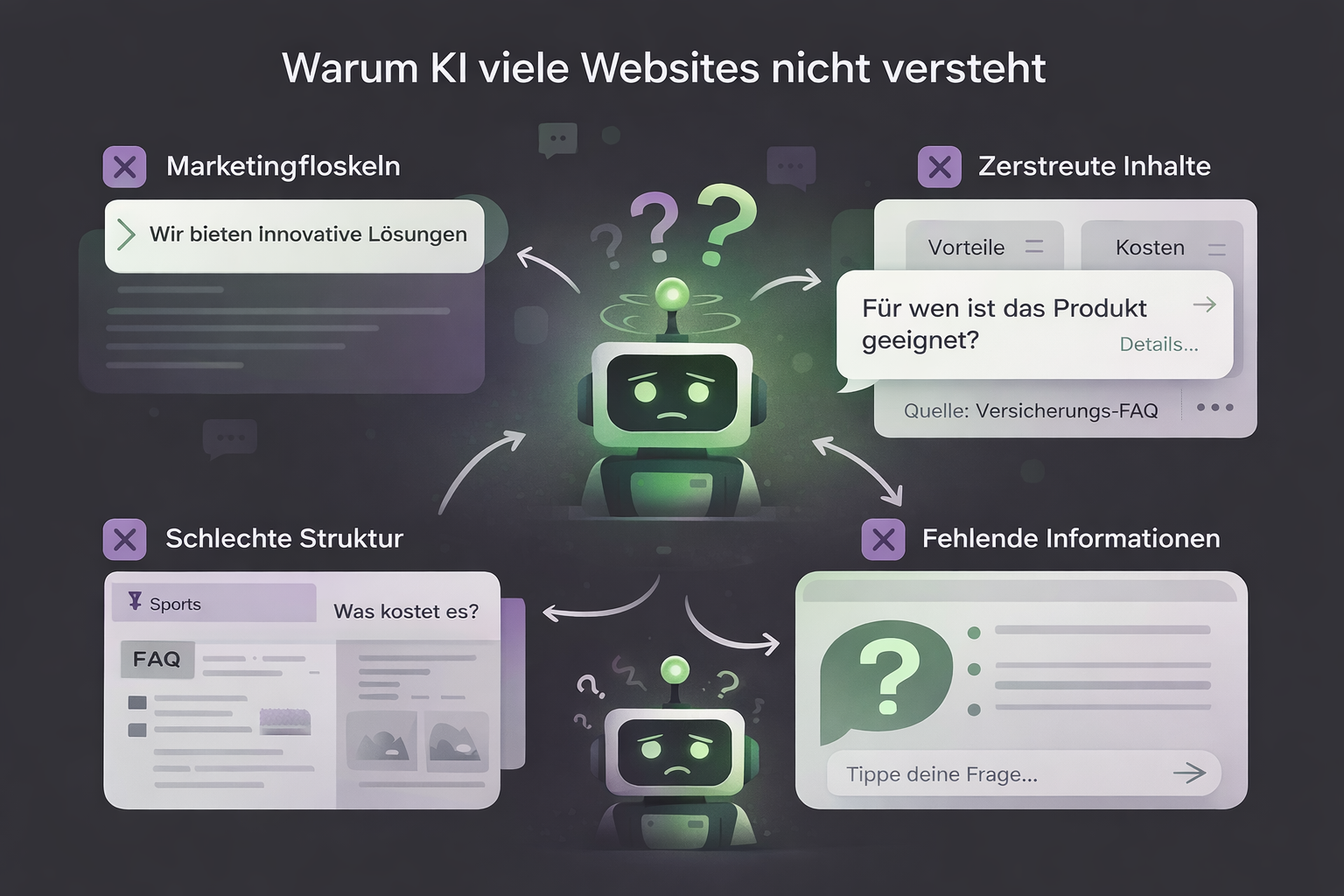
Four Reasons Why AI Doesn’t Understand Many Websites
In our analyses, we see the same patterns again and again.
1. Marketing Text Instead of Concrete Statements
Many websites consist of marketing language. Terms like innovative, holistic, future-oriented, or leading say little about the actual service.
AI models work better with concrete statements. For example: “Our platform automates customer enquiries in support.”
2. Important Information Is Spread Across Multiple Pages
People navigate through websites. AI models, on the other hand, try to derive answers directly from individual text passages.
If an answer has to be pieced together from five different pages, it becomes difficult. A page that answers a question completely is far more useful.
3. Content Is Poorly Structured
Headings, lists, and clear sections don’t just help people read – they also help AI systems. A well-structured article contains, for example:
- a clear headline
- a short classification
- subheadings with concrete questions
- examples or figures
This structure makes content significantly more understandable for language models.
4. Many Questions Are Simply Not Answered on Websites
This is perhaps the most common issue. Many websites explain products, but don’t answer the questions users actually have. For example:
- What does the solution cost?
- How does it work concretely?
- Who is it suitable for?
- How long does implementation take?
If these questions aren’t answered, AI can’t cite them either.
How Businesses Can Make Their Website More Understandable for AI
The good news is: you don’t need to build a completely new website. Often a few adjustments are enough:
- clear statements instead of marketing buzzwords
- structure content more along user questions
- formulate important information explicitly
- divide longer texts through clear sections
Particularly effective are pages that answer a concrete question. For example: “How does an AI chatbot work in customer service?” or “When is a website chatbot worthwhile?”
Such content is picked up by AI systems significantly more often.
A Simple Test
Many businesses don’t even know how understandable their website is for AI models. That’s why we’ve developed a small test. The LLMO-Check analyses:
- how clearly content is formulated
- whether important questions are answered
- how well the structure is suited for AI models
The analysis takes only a few minutes.
Conclusion
The way people search for information is fundamentally changing right now. In the past, we clicked through websites. Today we enter search queries on Google. And increasingly often, we ask our questions directly to an AI.
Businesses whose content is clearly formulated, structured, and comprehensible will appear more frequently in those answers. Not because they advertise better – but because their content is better understood.