
Why clear system instructions for AI tools are becoming increasingly important
Many people use AI tools like ChatGPT, Claude or Gemini on a daily basis. But most start every conversation the same way: from scratch. The AI knows nothing about the person it’s working with. Nothing about their company. Nothing about goals, projects or priorities. This leads to a familiar effect: the answers stay generic. You get a usable first draft, but then spend a lot of time correcting, rewriting or restructuring. One simple method can significantly reduce this problem: an AI Operating System.
What an AI Operating System is
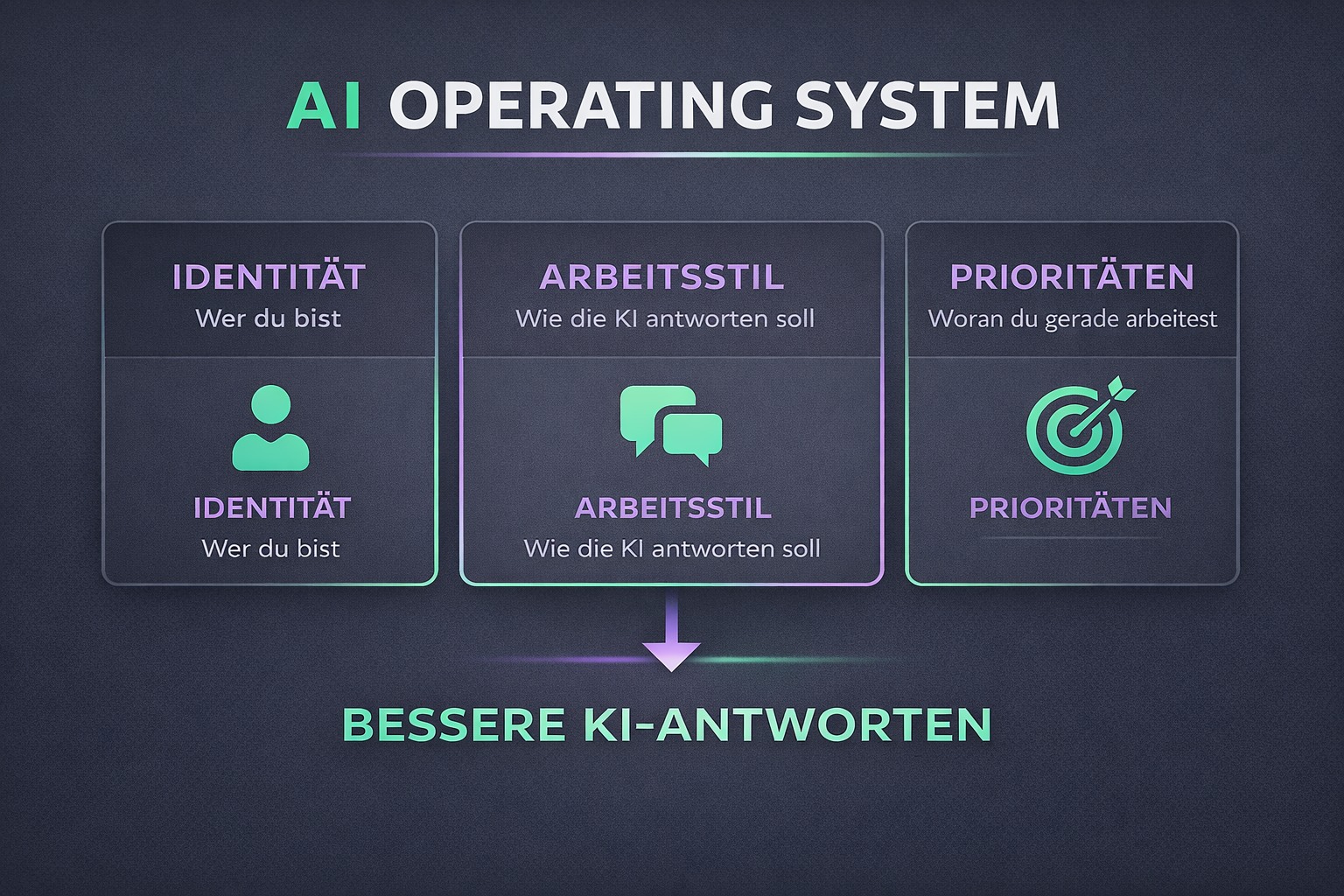
An AI Operating System is essentially a structured system prompt. It describes who you are, what you’re working on, how you communicate and what goals are relevant. This information is defined once and then stored permanently in the AI tool. This gives the AI context before any question is even asked.
A practical example with Claude
One particularly interesting use case for such system instructions is AI work environments like Claude. In these tools, you often work with the same AI instance on projects over an extended period – whether for content strategies, document analysis, product concepts or editorial work. When the AI has no context, it has to be explained again and again. An AI Operating System solves exactly this problem: the system prompt defines role, company context, communication style and current priorities once. The AI then works with this knowledge permanently.
The five building blocks of an AI Operating System
A functional AI Operating System consists of five elements. This structure ensures that the AI receives both context and clear expectations.
1. Identity
First, describe who the person or organisation is – name, company, field of activity, target audience. An example: “I am the CEO of a digital agency and develop AI solutions for companies.” This immediately tells the AI from which perspective questions are being asked.
2. Communication style
The second section describes how answers should be formulated. Typical rules include: direct and without filler text, clear language instead of marketing buzzwords, constructive feedback rather than mere agreement. This makes the AI adapt more strongly to your own working style.
3. Goals and priorities
An AI Operating System also contains current priorities – such as building a new product, developing a content strategy or optimising internal processes. The AI can then automatically filter suggestions through these goals.
4. Work structure
Temporal frameworks can also be helpful: deep work phases, meeting times, specific days for content or strategy. When AI helps with planning or prioritisation, such information is very valuable.
5. Things to avoid
The final section defines clear boundaries – no generic answers, no unnecessary repetition, no marketing buzzwords. These rules prevent typical weaknesses in AI answers.
Why this concept is becoming more important right now
As AI usage increases, so does the nature of collaboration with these tools. Initially, AI models were primarily used as question-and-answer tools. Today, they are increasingly evolving into genuine work environments. Especially in tools like Claude, a continuous collaboration between human and AI is emerging. An AI Operating System ensures that this collaboration remains consistent – the AI knows from the start who it’s working with, which goals are important and how answers should be formulated.
An AI Operating System is not a technical construct. It is a decision about how you want to work with AI.
Conclusion
Most people still use AI tools very spontaneously. They ask a question, get an answer and start again from scratch in the next conversation. An AI Operating System changes this dynamic. It creates context, consistency and clear expectations. This turns a simple AI tool into a work instrument that adapts to your own way of working.
Template: Your AI Operating System
Copy the text below and paste it into the system instructions of your AI tool. Replace the placeholders in square brackets.
## My AI Operating System

### 1. Identity
My name is [Name]. I am [Role] at [Company].
My field of work: [Description].
My target audience: [Target audience].

### 2. Communication style
- [e.g. Direct and without filler text]
- [e.g. Clear language instead of marketing buzzwords]
- [e.g. Constructive feedback rather than mere agreement]

### 3. Goals and priorities
My current priorities:
- [Priority 1]
- [Priority 2]
- [Priority 3]

### 4. Work structure
[Optional: e.g. Deep work phases in the morning, meetings on Tuesdays/Thursdays]

### 5. Things to avoid
- [e.g. No generic standard answers]
- [e.g. No unnecessary repetitions]
- [e.g. No beginner-level advice]
→ Part 2: Setting up an AI Operating System: Step by step for Claude and ChatGPT